

Intelligent Transport System road safety trial
This project is for the installation and trial of an Intelligent Transport System (ITS) road safety treatment to create a safer road environment for all road users.
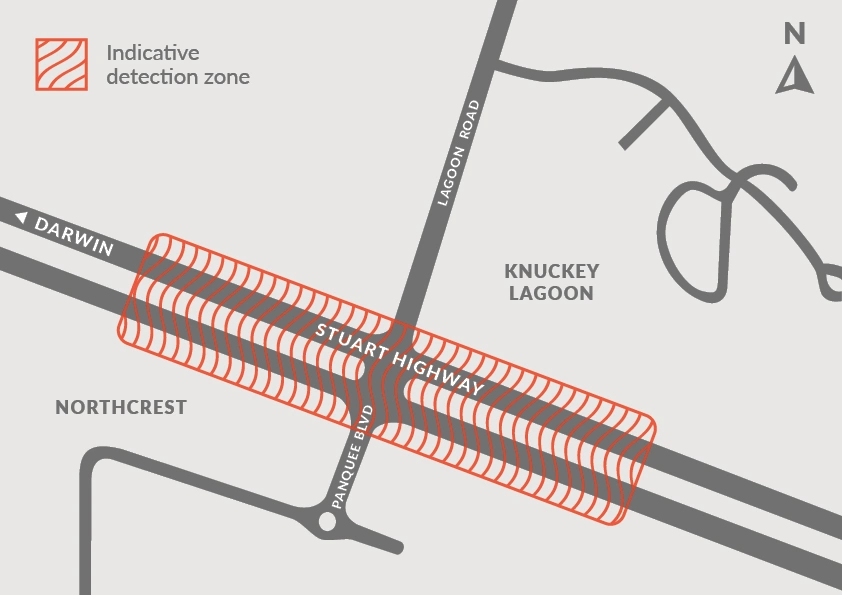
The system will be installed at the intersection of the Stuart Highway, Lagoon Road and Panquee Boulevard, Berrimah, and will extend approximately 200 m in either direction of the intersection along the Stuart Highway.
The ITS solution is designed to detect pedestrians in real time within a monitored zone in the traffic lanes, median and verge, and alert approaching motorists through any or a combination of:
- lowering speed limits using variable message signs
- digital warning signs
- increasing lighting intensity of streetlights.
Activation of the ITS will highlight the presence of pedestrians and reduce the chance of a collision.
The Stuart Highway in Berrimah adjacent to the Lagoon Road and Panquee Boulevard intersections has recorded a total of 21 crashes for the 10-year period between 2016 and 2025, including 2 pedestrian fatalities and 3 serious injuries.
Current and future residential, retail and commercial development nearby is expected to increase pedestrian movement in the area.
The Northern Territory Government is committed to road safety for all Territorians through a safer road transport system.
This project supports action 15 from the Towards Zero Road Safety Action Plan 2024-2028 PDF (9.1 MB):
- Investigate road-related pedestrian deaths and injuries and implement solution to address pedestrian road trauma.
The project will run from June 2026 to December 2027. The ITS solution will be trialled for 12 months and include ongoing evaluation throughout the trial period.
The trial will complement pedestrian and driver education campaigns to encourage the safe sharing of our roads.
Project funding
A budget of $2.5 million has been allocated for this project:
The project is jointly funded by the Australian Government and Northern Territory Government.
- Australian Government: $2 million
- Northern Territory Government: $500,000
Why smart technology is being used
Smart technology offers significant potential to deliver effective road safety solutions and its role in managing road networks continues to expand. DLI aims to move beyond relying solely on traditional infrastructure solutions and capitalise on the benefits and advantages of smart technology solutions.
Persistent safety concerns, such as pedestrians and drivers failing to comply with traffic signals, pedestrians crossing at unpredictable undesignated locations and drivers not yielding to pedestrians, call for smart technology-driven solutions.
The traditional road infrastructure is effective if it is used in its intended manner. Often it does not cater for road users’ non-compliant and unsafe movements.
This project will trial road safety smart treatments beyond traditional methods. It will be focused on motorists as the system will be designed to alert motorists in advance about the presence of pedestrians within the traffic lanes, medians and verges.
Why the Stuart Highway location was selected
The location has been chosen on the basis that there has been a total of 21 crashes for the 10-year period between 2016 and 2025, resulting in 3 serious injuries and 2 pedestrian fatalities.
Current and future residential, retail and commercial development nearby is expected to increase pedestrian movement in the area.
ITS and traffic signals
The ITS treatment is not intended to replace the traffic signals at the intersection.
The ITS treatment is being trialled to provide an enhanced road safety solution to address unsafe road user behaviours at the intersection and along the approaches.
This smart solution provides additional road safety treatments on top of the traffic signals.
Using pedestrian crossings
The ITS does not replace the NT road rules (Traffic Regulations 1999). Pedestrians are required to obey the road rules, including crossing at signalised crossings.
Traffic flow and congestion
The ITS is not expected to noticeably disrupt traffic flow or create congestion.
The ITS will continuously monitor the road environment and only activate the roadside devices to alert traffic when a pedestrian is detected. At all other times, traffic will flow normally.
Trial period and evaluation
The ITS will be trialled for 12 months and include ongoing evaluation throughout the trial period.
Future rollout considerations
If the evaluation demonstrates that the trial is effective in improving the safety of and reducing the risk to pedestrians, the system may be deployed at other high-risk locations on a case-by-case basis.
Privacy and data management
The ITS uses light detection and ranging (LiDAR)-based detection, supported by CCTV, to identify pedestrians and vehicles entering the monitored zone.
The LiDAR sensors detect the presence, position and movement of people and vehicles. They do not capture images, faces or number plates and cannot identify individuals — the detection data is anonymous.
CCTV cameras record video and are used only to commission (set up and calibrate) the system and to review specific safety events. The cameras are not monitored continuously and are not used to identify individuals.
Privacy is protected through the following measures:
- CCTV footage is retained for 120 days and then automatically overwritten.
- All data is stored securely in Australia within the Northern Territory Government data centre.
- Cloud-based monitoring of the system is read-only.
- The system does not perform facial recognition or automatic number-plate recognition.
- Information is used only for the ITS trial, including detecting pedestrians, refining the system design and evaluating effectiveness.
Use of collected information
LiDAR and CCTV systems will be used solely to improve road safety and will not be used to issue traffic infringements.
LiDAR sensors detect and track road user movements without collecting identifiable information such as photographs, faces or licence plates, enabling the system to identify hazardous interactions and activate safety warnings. CCTV cameras support system commissioning, calibration, monitoring and the investigation of crashes and near-misses, helping to verify system performance, understand road user behaviour and assess the effectiveness of safety treatments.
Contact
To find out more information, contact Principal Traffic Engineer Aftab Abro on 8924 7121 or email Aftab.Abro@nt.gov.au.
Give feedback about this page.
Share this page:
URL copied!